Wednesday, March 25, 2015

A Mirror In Outer Space

A first time ever experiment is occurring later this year on the international space station. In the coming years, humanity hopes to embark on journeys reaching further into space than ever before - eventually hoping to send individuals on a manned mission to Mars. Before they can do this, however, more must be understood about how exactly the human body functions in space, and what adverse effects life in microgravity have on the human body. Later this year, astronaut Scott Kelly will embark on the first ever year long mission aboard the International Space Station, which will be the longest continuous time that anyone has spent in space. Kelly will be performing other duties while on this mission, but the mission's main focus will be studying the effects of long term residence in a microgravity environment. Conveniently, Kelly has a twin brother (who is also an astronaut) who will be monitored on earth during Kelly's stellar excursion, providing a control for the experiment, and hopefully allowing researchers to ascertain a deeper understanding of physiology in space.

Astronaut twins Scott (on the left) and Mike Kelly. 

Thanks to evolution, the human body is pretty well adapted to living on earth. Most of our physiology is based upon being pulled down on by a force of 9.8 m/s/s, and once you remove this force, strange things begin to happen. The biggest effect is felt in the astronaut's lower body, as this part (which has spent its entire existence supporting something) suddenly doesn't have anything to do. The load bearing bones (the legs, hips, and spine) begin to break down, releasing calcium into the body (doctors call this phenomena spaceflight osteopenia). This causes the bones to become more brittle, increasing the chance of a fracture. The release of calcium into the astronauts system can also increase the likelihood of kidney stones. This reduction occurs at a frightening rate, up to 1.5% of load bearing bone mass lost per month.

Alongside bone loss, astronauts also experience some degree of muscle atrophy. Much like the load bearing bones, the muscles in ones back and legs experience a reduction in use, which results in their weakening; without proper exercise, astronauts can lose up to 20% of their muscle mass in 5 to 11 days. Up until now, astronauts have bungie corded themselves to a treadmill, used a stationary bike, or have used a device called ARED (which simulates weightlifting) to help stave this off, but research is still being done to improve interstellar fitness.

Body Fluid changes in Outer Space
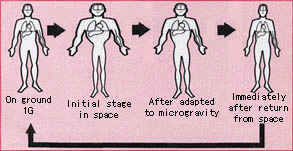
Another physiological challenge that astronauts face in microgravity occurs within their fluid systems. Gravity plays a huge part in how our bodies manage fluids. Once an astronaut enters a microgravity environment, his or her fluids (which are no longer being pulled down by gravity) being to congregate in the upper body, resulting in symptoms that resemble the common cold. Plasma volume (the water in the blood stream) can decrease up to 20%, which can result in something called Orthostatic intolerance, which is the loss of the ability to stand without help for more than 10 minutes at a time. This effect is exacerbated with longer stays in space, but so far no astronaut has failed to recover once they have returned to Earth. A reduction in body fluids puts less stress on the heart than would normally occur, which causes the heart to atrophy as well, which lowers blood pressure. This can cause complications once the astronaut returns to a gravitational environment. Shifting fluids also result in an increase in intracranial pressure. This in turn puts pressure on the optic nerve, which can cause vision problems in astronauts.

Why is all of this stuff such a big deal? Currently, we want to send people to Mars, a journey which will take six months with today's technology. Since there aren't any hospitals on Mars, anyone who goes there will have to be in a condition in which they'd be able to survive the harsh conditions of a foreign planet, which is something that hasn't quite been figured out. Hopefully NASA will be able to gain some important insights from the Kelly mission that will allow a better insight into how to treat space adaptation syndrome.

Posted by David Almanzar (Group A)

Mangabees

    Manganese is a metal that in very small amounts, is actually necessary for life as we know it. Manganese is normally found in such small traces that many cells express a gene that produces a protein to pump manganese into our cells from our environment. In recent times humans have been unearthing many metals that would normally be resting under the surface due to industrialization and one of these metals is manganese. Manganese is a common byproduct of industrialization and the levels in the air have been rising dramatically.
    While the levels of manganese have been kept under control enough to not be harmful to us or our food directly, these high levels could be causing a much bigger problem that lacks urgency due to its subtle nature. Recent studies have shown that these high levels of manganese have drastically effected the efficiency of bees in their foraging tasks. The studies focused on how the manganese levels effected dopamine levels in the brains of bees. These altered dopamine levels caused bees to take on less foraging tasks and be less efficient in their tasks.
    These facts could be very dangerous to humans and for that matter, all life on the planet. Bees are crucial to our lives and their number are already on the descent. Bees are responsible for all the fruits and vegetables we eat being pollenated so that growth can ensue. If bees were to no longer be functioning as efficiently and in lower numbers there would surely be a major decrease in the availability of fruits and vegetables which would trickle down even further to preventing the animals that we eat for meat from getting their own sufficient diets.
    So while global warming and other human impacts on the Earth may be stealing the spotlight, we humans have severely affected our planet in many ways. Small, almost unnoticeable effects such as an increase in manganese levels may not seem urgent and may seem minuscule but nonetheless it can be a planet killer. If actions against the rise of these levels are not taken humans could be in for a rude awakening in the future whether it be from the downfall of our necessary companions; the bees, or from human brains being affected in the same way once the levels of manganese climb to a detrimental point.
This is the article from which I learned most of this stuff if anyone wants to go check it out. ://www.sciencedaily.com/releases/2015/03/150324210043.htm

Cullan Bartel, Group A

Crayfish (invertebrates) suffer from anxiety as well..

A work, published in Science by French researchers from Université de Bordeaux (France), shows the presence of a neural mechanism of an anxiety-like behavior in animal, specifically crayfish, throughout evolution. It is claimed that anxiety has only been found in human and a few other vertebrates. This is the first case discovered in the history that anxiety-like behavior also exists in invertebrates. Additionally, they have also found that this emotion weakens and disappears as anxiolytic is injected (suggesting a similar mechanism as in human).

 Figure 1: Photo of a crayfish used in the experiment (in the cross-shaped mazed)

First of  all, anxiety is a form of behavioral response to stress, including lasting fear and nervousness. This involuntary response raises awareness and the ability of detecting threats in individuals, consequently, increasing their life expectancy.

During experiment, researchers repeatedly exposed crayfish to an electric field (stress environment) for thirty minutes before placing them in an aquatic cross-shaped maze. The maze was set up in a way that two of its arms were lit up and the other two were kept dark. Dark area was found to be reassuring for crayfish. Results of the experiments illustrate a tendency that those that are anxious stay in the dark arms of the maze and those who are not anxious (in the control group) remain throughout the whole maze.

From a neuro-biological standpoint, this anxiety response is related to an increase in serotonin level in brain. This neurotransmitter, is responsible for the feelings of well-being and happiness is released when body experiences stress, suppressing anxious feelings. Researchers have also injected a dose of anxiolytic, commonly used in human (benzodiazepine), to crayfish and found similar effects as if in human: weakening the symptoms of anxiety.

Researchers believe that this analysis of this ancestral behavior will essential for studying the neuronal bases of this emotion. This is also a behavioral study on a unique model, which is invertebrates. Further studies can be done based upon the finding from this experiment. 

Posted by Phi Duong (Group A)

Sleep Deprivation

      As college students, we are always bombarded with a load of work all at once, and run on little, to no sleep. This seems to occur mostly during midterms and finals week, or a random "hell week" during the semester, when it seems like professors plot against us students, and  schedule all exams and have everything due within the same week. I am currently  going through one of those random "hell week" and running on 8 hours of sleep since Monday. I am in great need of sleep, and find my self dosing off during lectures and on the bus back home.
       It is said that college students are the most sleep deprived. A Research done in 2001 at Brown University was done where they found that approximately 11% of students report good sleep, while 73% report sleep problems. In the study, students reported that the top reasons preventing them from sleep included: dorm noise, socializing with roommates, schoolwork, and personal health issues. Sleep is a very important part of a healthy lifestyle. Not doing so will hinder the ability for our brains to function properly,and our body to stay healthy, both physically and mentally. Sleep deprivation can affect important aspects of your mind and body such as your mood, energy, ability to learn, memory, good judgment, reaction time and efficiency.  
      Three  advice on helping you sleep better is: stop all usage of technology 30 min prior to bed, yes this includes cell phones. The light block melatonin which can help you fall asleep.  A 30 min wind down with relaxation and reading can make it easier to fall asleep. The second advice is no caffeine after 3:00 PM. Caffeine and nicotine are stimulants, which disrupt sleep, so if you feel like you need a drink in order to boost up your energy, try a small energy booster snack or drink. The last advice would be to sleep only an hour longer during the weekend than you usually would on your latest weekday wake-up time. Therefore, don't rely on the weekend to catch up on sleep but this only worsens your sleep pattern. The best solution is to get a regular amount of sleep as many nights as possible. 


Posted By: Barbara Afogho (Group A)

Thursday, March 12, 2015

Save the Whales?

Save the Whales? 

You may have heard of what has come to be a cliche environmental activist pitch of "Save the Whales!".  It comes up in movies, television shows, and sometimes occurs in real life.  Some people will keep walking, act like they're listening to headphones.  Now I personally am not an environmental activist, and I don't usually think about animal cruelty in my spare time but I recently saw the documentary "Blackfish" about Orcas in captivity.  It was eye opening and made me think again about animals, especially Orcas being kept in their unnatural habitat and subject to captivity.  I remember going to Seaworld when I was younger and being amazed by all of  the animals, and the "tricks" they could do.  I never thought about how the animals could feel (and yes Orcas can feel, scans show they might have even deeper emotions than humans).  But watching the documentary expose how Orcas were taken from their homes and their families where they had close bonds made me think about what humans are actually doing.

 The documentary was mainly about an Orca, Tilikum, who is currently being kept in captivity in Florida.  Tilikum has injured multiple trainers even killed some..  Researchers believed Tilikum was in a sort of psychosis due to being held in solitude, injured by the female Orcas he was in his minuscule tank with, and not getting rewards for his "tricks".  Even though Tilikum allegedly killed three humans he is still being subjected to performing, but his "punishment" is being in a tank in solitude only  performing a couple stunts for shows and being used for breeding.  This arises the question, is it fair to Tilikum and other Orcas to be blamed for the killing? Or the people around them.  Orcas have only harmed one human in the wild, and killing none; yet in captivity they have injured over one hundred, killing four.  The people who captured the young Orcas from their family when they were only a couple of years old.  It was even reported that when humans first began hunting Orcas to hold them in captivity, they would take the pups, and sometimes kill the older Orcas they were with which is highly illegal.  Yes, it is illegal to kill Orcas in the wild, but isn't taking Orcas into captivity essentially killing them? It reduces their life span by 70%, but they definitely didn't tell me that when I was visiting Sea World (they actually say that Orcas live longer and happier lives in captivity due to veterinary care which is not true).

 There are currently 57 Orcas in captivity, 24 of these being in the United States.  I am in no way saying that watching animals isn't entertaining, I go to the zoo and as I mentioned I've been to Sea Worlds and had fun! But can we really keep animals in captivity for our own enjoyment, even if its detrimental to them? How would us humans feel if one day a superior animal arose they put us in small cages and pools and forced us to do tricks in order to get fed.
Fate of Captive Orcas
PBS - Ethics of Captivity
Netflix - "Blackfish" directed by Gabriela Cowperthwaite

Posted by Victoria Bortolussi (C)


Wednesday, March 11, 2015

How to Stay Healthy: Exercise Regularly, Avoid Junk Food, and Eat Your Boogers

How convenient...
Picking your nose is pretty gross, right? Right. You don’t have to be overly squeamish to agree… digging for gold in public is about as socially unacceptable as laughing at a funeral. How could it get more repulsive? How about this -- picking your nose and then eating it. Just the thought of it makes me cringe… and it brings up a sour old memory of this girl I used to go to elementary school with. Megan (she’ll never read this) was a normal, happy-go-lucky girl, who just so happened to have this sincerely unfortunate habit of picking her nose and then eating the… well, you knowHer notoriety was well-known throughout the school, and her status as a routine sinus-harvester was a day-to-day hot topic on the playground. Once we moved on to middle-school, she must have had some sort of social epiphany, because her nasal fixation and booger consumption thankfully stopped being a thing. Though her habit had dismantled, her reputation remained -- and all throughout highschool I could never bring myself to forget the infamy she brought upon herself.

This isn't Megan...
But maybe Megan wasn’t all that crazy… tons of toddlers and young children exhibit this behavior. It even has its own word -- mucophagy. Could it possibly be evolutionarily-inspired? University of Saskatchewan biochemist Scott Napper thinks so. Napper has theorized that eating boogers poses a survival benefit by introducing to the immune system pathogens and germs that have been trapped and entangled in nasal mucus. Austrian medical doctor Friedrich Bischinger agrees -- he notes that snot contains a powerful biochemical arrangement of antiseptic enzymes that cripple and kill harmful bacteria. Orally introducing these weakened microorganisms could potentially allow the immune system to assess these antigens for antibody production -- all while providing little to no harm to the human body. Napper even suggested that since boogers have a sugary taste (although I cannot vouch for that), mucus may provide a tasty incentive for young children to chow down.

Antibodies in the bloodstream
While no real studies have been done to confirm this hypothesis, it’s very interesting to think of how this socially frowned-upon habit expressed commonly in children could have evolved to protect the human body from germs. As a side note… I sincerely apologize if you chose to enjoy your lunch while reading this post, but just consider it “food for thought.” The next time you’re feeling like a hypochondriac, enjoy yourself a snack from the goldmine and rest assured -- it’s biology! Also, let me know if you notice any difference in immunity, because I won’t be trying this one out for myself!

Posted by Michael Salhany (6C)

Genomic analysis paints the picture for our primate ancestry

Genomic Analysis Paints the Picture for our Primate Ancestry

               Genome sequencing technology is breaking new ground on the human genome by studying our genetic neighbors. The very first non-human primate genome that was sequence and published is the chimpanzee, using shotgun de novo assembly. With the exception of gibbons, every hominid species has its genome fully sequenced. With all this genomic data, we can paint an incredibly accurate phylogenetic tree. Before, we would make trees using only one gene as a reference, which would lead to false positives on which species were more closely related. If we observed just one gene, we could come to different conclusions. For example, one particular gene between gorillas and humans may be coincidentally close, and if we use that gene as a basis, then we would come to the conclusion that humans are most closely related to humans. We're fairly certain that this isn't true, because we've used the entire genome to get an average of closeness for each gene. Our current model looks like the tree below;
Primate phylogenetic tree.
                How do we reach these conclusions with DNA? A lot of techniques revolve around comparing the percent of similar DNA of specific types. Humans and chimpanzees have DNA that has about 1.4% difference in DNA, but this only accounts for nucleotide substitutions, not for small insertions and deletions in the genome. When you compare small insertions and deletions, the differences get much bigger. What's the value to this? The more differences we can discern from DNA, the easier it becomes to differentiate them. We're no longer working with fraction percent differences, and it becomes much clearer who is closely related and who is not. Insertions and deletions may account for major evolutionary mutations, so they cannot be ignored.


                Even if you think DNA is totally bogus, scientists make an effort to support their claims with interdisciplinary evidence. Scientists have retroactively supported their theories on the close relation to bonobos and chimpanzees by observing their behavior and examining the ecological past of their environment. Bonobos have a matriarchal society where females form close bonds to gain an advantage against males. Chimpanzees don’t have this behavior. Scientists believe this has to do with the feeding opportunities that these species have experienced in their evolutionary past. The common ancestor of chimps and bonobos once coexisted with gorillas, which consumed all the food on the ground and forced the ancestor to be arboreal to eat tree food. At some point, this environment suffered a drought, so the ground plants and gorillas were wiped out as a result. The chimp ancestors were able to survive, and once the ground plants grew back (and the gorillas didn’t), the chimps were able to capitalize on the abundance of food. These chimps eventually evolved into bonobos.
There is a video on national geographic that details it here.

Posted by Patrick O'Loughlin