Thursday, April 6, 2017

Love at First Bite?

Love at First Bite?

Ladies, have you even been on a date or eating with your guy friends and noticed that they’ve eaten a whole lot more than you have? Guys, have you ever wondered why the girl you’re eating with decided not to go for seconds?  Well it turns out males aren’t simply hungrier than females, there’s actually a biological reason for why men eat more food in the presence of women.

In an experiment from the Cornell Food & Brand Lab, researchers determined that on average, while in the presence of the opposite sex, men will consume more food.  This experiment was done in an all-you-can eat Italian buffet style restaurant.  105 individuals were observed over the course of two weeks. Information recorded by the researchers involved the gender of the subject as well as how many slices of pizza and bowls of salad they consumed while dining. In addition, each subject was given a short survey as they left the restaurant answering questions like: how hurried did they feel while eating, how comfortable were they, and how full did they feel when they were done?

What the researchers found was a significant increase in the food consumption by men dining with at least one women.  Men ate 93% more pizza and 86% more salad when with a female companion compared to eating with only other males.  Whereas for females, there was no significant difference in the amount of food they ate depending on who they were with.  From the surveys, it was found that women felt that they overate and felt rushed when eating with men. It is interesting that this article does not mention the men’s feelings of fullness or hurriedness while they ate. 
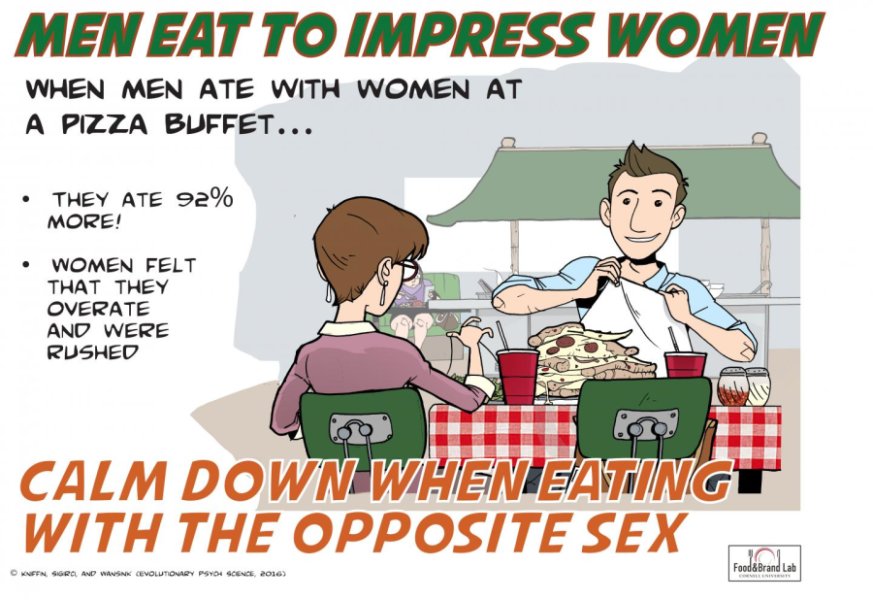


A conclusion drawn from this experiment was that men tend to eat more to show off when they dine with females.  This is also evident in food competitions, where there are mostly male competitors.

Why would men eat more than women in the presence of the opposite sex? While the article does not bring up any ties to evolution, I think it is an interesting point to bring up, and really the only explanation.  In the context of natural selection and female choice, we know that females will choose the most qualified and usually the most impressive male to mate with in order to produce offspring.  So perhaps males have a biological tendency to impress females with the amount of food they are able to consume in an effort to win them over.  So guys, next time you’re on a date, just remember that even though evolution might be telling you your date will be impressed with all that food, she might think otherwise.


Posted by Taylor Irwin (Group B)


Source photo & article:

Wednesday, April 5, 2017

Deadly Addictions

Deadly Addictions

In the United States, cigarette smoking kills more than 480,000 people each year; it is the leading cause of preventable disease and death in the nation. This is truly mind-boggling when the negative consequences resulting from extended cigarette use are known and well studied. I’d say it is a fair assumption, that everyone in the Unites States is aware of the health complications posed by extended cigarette use, for many the complications, such as lung cancer and emphysema, hit a little too close to home. It is hard to find an American who doesn’t know at least one person who smokes or used to smoke.

While cigarette smoking is a common addiction and leading cause of death in the United States, another deadly addiction is sweeping across other parts of the world. In Southeast Asia, as many as 600 million people chew areca (or betel) nuts; the common preparation, referred to as a quid, is prepared by mixing sliced areca nuts, slaked lime, spices, sometimes tobacco, and wrapping it all in leaves from the betel vine. It is so common in some nations, such as Taiwan due 
to the feeling of euphoria it induces; it is referred to as the nations “chewing gum”. Its side effects are detrimental; it is causing oral cancer in users up to 20 years after the user’s last chew. The lime that is added is particularly horrible, it causes tons of abrasions on the inside of the mouth, which then allows all of the cancer causing chemicals in the mixture to harm the users. Use of this concoction also causes their saliva and teeth to turn a bright red; so much so that sidewalks are said to be permanently stained red from people spitting the “quid juices”.


This addiction isn’t limited to adults, although most common amongst working class men, women and children also chew the quid (which makes the habit even more alarming). What is worse is the people are unaware that the high rates of oral cancer are linked to the addiction. It is said to be, one of the most popular mind-altering substances in the world, alongside nicotine, alcohol and caffeine.

Both quid chewing and cigarettes are exposing millions to known carcinogens. It is imperative the people of South Asia be educated about the negative health consequences of the popular substance use.

So what is being done to help the millions of people using cigarettes or chewing quid to curb these two addictions? Surprisingly, the research is being done on the two substances simultaneously.


Arecoline's chemical structure: can it curb the deadly addictions?
A recent study notes that researchers have found new insight to a possible new drug that could help both smokers and quid chewers quit their deadly habits. There are some drugs currently on the market to help smokers quit, but many of them come with negative side effects. One example is Vareceline, the negative effects happen because the drug targets multiple types of nicotine receptors, not just those involved in the addiction. Papke and Horenstein of the University of Florida have found a possible alternative: arecoline. It is one of the psychoactive alkaloids in the areca nut. It stimulates the same receptors responsible for nicotine addiction, but doesn’t stimulate the receptors associated with the side effects of other drugs. The arecoline analogs that they have synthesized (hey look, a practical use for organic chemistry!) may be able to treat these addictions without side effects. Let’s hope they get the funding they need and get it on the market as soon as possible because these two addictions are killing a staggering number of people each year.

Posted by Jenna Lansbury (B) 

Sources:

Pictures:


Tuesday, April 4, 2017

Can a Magnet Help You Lose Weight?

Can a Magnet Help You Lose Weight?

According to a new study, it can. A noninvasive electromagnetic brain stimulation technique, called Deep Transcranial Magnetic Stimulation (dTMS), is capable of changing the composition of the bacteria in the gut. This technique has been found to reduce food cravings and induce weight loss in obese people. The process involves placing an electromagnetic coil on the scalp which sends magnetic pulses to specific regions of the brain. Scientists have discovered that one underlying cause of obesity is an imbalance of the digestive track’s microorganisms. This improper mix of beneficial and harmful bacteria is known to impair the brain’s signals for hunger and satiety. This electromagnetic brain stimulation can potentially solve this imbalance.


In a study funded by the Italian Ministry of Health, 14 obese individuals were assigned to be a part of either an experimental group or a control group. The experimental group received 15 dTMS treatments over a five-week period, while the control group received 15 sham stimulations over the same five-week period. After the experiment had ended, those receiving dTMS treatments lost more than 3% of their body weight and more than 4% of their fat. Also, an analysis of their fecal matter showed a significant increase of beneficial bacteria with anti-inflammatory properties. These changes in bacterial species correlated with improved metabolic and hormonal measures such as glucose, insulin, and many pituitary hormones. The control group showed no changes in their microbiota composition nor any changes in their weight or fat percentages.

Does this mean that all it takes to lose a few pounds is sending magnetic pulses to the deep regions of your brain? With the help of dTMS, maybe. Once the results of this study are presented this Sunday at ENDO 2017, I’m sure additional research into deep transcranial magnetic stimulation to solve the obesity epidemic will take off.


Posted by Caitlin Lohr (2)


Sunday, April 2, 2017

The "De-extinction" Dilema

The "De-extinction" Dilema

How cool would it be to see the extinct giant woolly mammoth roam the Earth again?! Scientists have become increasing close to making this possible by splicing ancient mammoth DNA into Asian Elephant DNA. Bringing back mammoths would be an incredible scientific breakthrough, but what if this breakthrough comes at the cost of losing the currently endangered elephant populations or decline/extinction of species who now inhabit the niche left by the mammoth?


Scientists are now tackling this dilemma. Many scientists are arguing that DE-extinction is too expensive and that this funding should be used to help the currently endangered species. It is estimated that it would cost tens of millions to resurrect extinct species. Many scientist also argue that this process is not 100% and could possibly not even work. With the millions invested in the DE-extinction of one species many critically endangered species could be conserved. The costs here may outweigh the benefits.

Garnette Goorahlal group A
Source of Article: https://www.nytimes.com/2017/03/20/science/revive-restore-extinct-species-dna-mammoth-passenger-pigeon.html?rref=collection%2Fsectioncollection%2Fearth&action=click&contentCollection=earth&region=rank&module=package&version=highlights&contentPlacement=2&pgtype=sectionfront