Wednesday, March 7, 2018

The Door To Hell


The Door To Hell

Deep within the Karakul desert in Turkmenistan lies what locals call the “Door to Hell”, a 70 meter wide and 20 meter deep crater that has been constantly ablaze for 45 years. 

The formally known Darvaza gas crater was originally stumbled upon by Soviet engineers in 1971, who deemed it a plentiful oil field site and set up exploratory measures to estimate the amount of petroleum it held. Soon after discovering a natural gas pocket located just underneath the surface of the desert, the surrounding ground collapsed in on itself creating a huge sinkhole and began emitting noxious gases.

Darvaza Gas Crater, Darvaza, Turkmenistan

In an attempt to minimize the potentially harmful effects of the gas, the engineers resolved to set the entire crater on fire, hoping to burn off the dangerous gas. Originally the fire was predicted to last only a few days to weeks, but after a whopping 4 decades the crater still burns today with no clear sign of ceasing. Geologists studying the area are unsure for how long the fires will persist, as Turkmenistan's land is substantially rich in natural gases.


The President of Turkmenistan, Gurbanguly Berdimuhamedow, visited the site in 2010 and declared that the sinkhole be closed, however the request initiated little action to fill the crater. Three years later, Berdimuhamedow returned to the site and announced that the section of the Karakul desert containing the crater be considered a nature reserve.


Posted by: Grace Houghton
Week 4

The Power of Love


The Power of Love

When we go through a sad or difficult time and our morale is low, one of the first places we turn to in an effort to feel better is a loved one. I mean, a hug from a friend, significant other, or parent can take all of our pain away, right? It turns out that researchers at the University of Colorado Boulder and the University of Haifa conducted a recent study that suggests that this may be true.


The study looked at 22 heterosexual couples, age 23 to 32, who had been together for at least one year. Using electroencephalography (EEG) caps to measure their brain activity, the couples completed several two-minute scenarios. During the trials, the couples were asked to sit in various positions, ranging from 1) sitting together but not touching, 2) sitting together and holding hands, and 3) sitting in separate rooms. These same scenarios were then repeated, but the woman was also subjected to mild heat pain on her arm. Astoundingly, the researchers found that merely being in each other’s presence (with or without touching) resulted in brain wave synchronicity in the alpha mu band, which is a wavelength associated with focused attention. And if the couple held hands, the synchronicity increased even more. This phenomenon is regarded as “interpersonal synchronization”, which simply indicates that people physiologically mirror the people they are with. On the other hand, the researchers found that when the female was in pain and the man was not allowed to touch her, the coupling of the brain waves diminished. Thus, the results of the study appear to suggest that “pain totally interrupts this interpersonal synchronization between couples and touch brings it back,” as explained by Pavel Goldstein, the lead author of the publication.

Another notable finding of the study was that subsequent tests of the male partner’s level of empathy revealed that the more empathetic he was to the female partner’s pain, the more their brain activity synced up, and thus, the more her pain subsided. The authors agree that future studies should look into explaining this phenomenon, but perhaps one rationalization is that empathetic touch makes a person feel understood, which in turn activates pain-killing mechanisms in the brain. Future studies should also explore if this same phenomenon exists within same-sex couples, or in other types of relationships. But for now, Pavel explains that the take away is “Don’t underestimate the power of a hand-hold.”

Story Inspiration:
https://www.sciencedaily.com/releases/2018/03/180301094822.htm

Journal reference:
Pavel Goldstein, Irit Weissman-Fogel, Guillaume Dumas, Simone G. Shamay-Tsoory. Brain-to-brain coupling during handholding is associated with pain reductionProceedings of the National Academy of Sciences, 2018; 201703643 DOI: 10.1073/pnas.1703643115

-Posted by Nicole Ayres (1)
Post #2

Mermaid Wine Glasses

Mermaid’s Wine Glasses

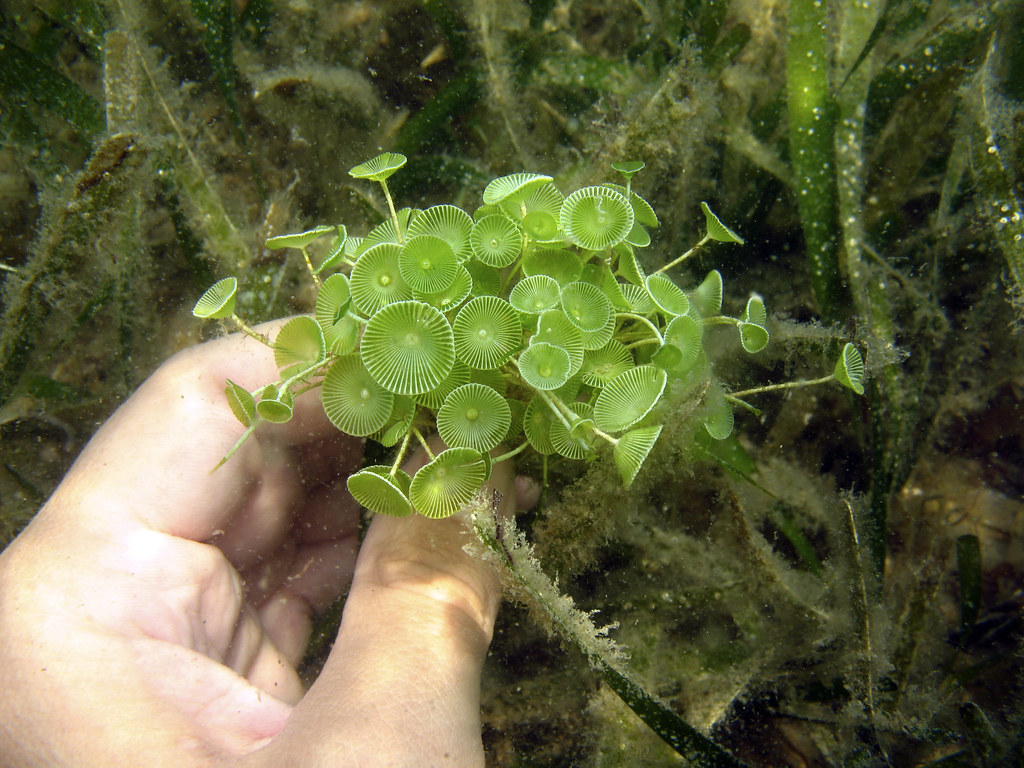
There will always be an exception to the rule. As a general rule of thumb, individual cells require a microscope to be seen. This is where Acetabularia comes in. These single-celled organisms – sometimes called “Mermaid’s wine glasses” – can grow up to about 10 cm tall. They are comprised of 3 main sections from bottom to top; root-like rhizoids (“feet”), a thin and long stalk, and a “cap” of branches that may be fused or not depending on the species. The nucleus is located at the bottom of the stalk or in the foot. This fact was crucial to research done by Joachim Hammerling.

Acetabularia mediterranea


Hammerling used Acetabularia mediterranea (A. mediterranea) as well as Acetabularia crenulata (A. crenulata) in his experiment. The morphology of A. mediterranea is such that the branches of the cap are fused together forming a bowl shape, whereas the branches of A. crenulata are not fused and create a look similar to that of a flower. The feet of each species were cut off and fused to each other’s stalk + cap types. Then, the caps of each were cut off. The first time, the cap types that grew back were paired with the stalk type that they grew on since the appropriate proteins remained in the cytoplasm of the stalks. The caps were again cut off and grew back such that they were paired with the foot types because of the presence of the nucleus. Through this experiment, Hammerling discovered that the nucleus is what controls the cell.

Acetabularia played an important role in this discovery. They were an excellent choice because the entire cell can easily be seen by the naked human eye and can be handled by the human hand. The plainly visible difference in cap morphologies allowed researchers to easily determine which morphology the cell was adhering to once the nuclei were swapped between cell types.

Source 1: https://www.britannica.com/science/Acetabularia 
Source 2: http://www.accessexcellence.org/RC/VL/GG/hammerling_s.html 

Posted by Natasha Dalton (1)

Enzymes!

I am currently studying for my Biochemistry 420 exam and figured why not use this space to test my knowledge on enzymes and the importance of inhibitors.

An enzymes main purpose in our cells is to speed up reaction rates by lowering the activation energy at the transition state. The reason that enzymes interact with the substrate the most at the transition state rather then with the reactants is due to the amount of interactions it would need to break in order to proceed with the reaction. With the most interactions taking place in the beginning of the process there would be no incentive for the reaction to proceed seeing as though the enzyme and substrate are happily bound together. Due to the fact that substrates and enzymes are always moving, the enzyme will bind with the substrate and limit its ability to change shape forcing it to change conformation into the transition state of the reaction, this is when optimal interactions will take place.


There are two main types of enzymes, Michaelis Menten and allosteric, each demonstrating key differences between enzymes and their abilities. Michaelis Menten is a kind of enzyme that demonstrates a hyperbolic curve whereas allosteric enzymes portray a sigmoidal curve due to their feature of having multiple subunits. The subunits of allosteric enzymes can be in two forms, either T form or R form, meaning they are less active or more active respectively. Positive cooperativity takes place between subunits of an allosteric enzyme when switching from the T form to the R form. This means that when one substrate binds to a subunit in the T form is causes the substrate to change conformation therefore causing a conformational shift in the neighboring subunits resulting in more R form. With more R form of the enzyme, the affinity is increased allowing the substrate to be more likely to bind to the enzyme. 

One main way to regulate enzyme function in a cell is through the production of inhibitors. Inhibitors can get very tricky due to the fact that there are many different kinds of them. Not only are there irreversible and reversible kinds, but there are also competitive, uncompetitive and mixed. These all depend on where the inhibitor binds as well as whether it is to the free enzyme or the enzyme substrate complex. To get even more complicated there is another type of inhibitor that falls under the mixed category called noncompetitive, just a special case of mixed inhibitors. Each of these reversible inhibitors have a different effect on the Km and Vmax of the reaction which is key in terms of identifying which inhibitor is being used when looking at a graph.

Although enzymes can get complicated they are still an essential part of our cells and our bodies could not function properly without them!

Image: http://www.bioinfo.org.cn/book/biochemistry/chapt08/bio1.htm

Posted by Sarah Aboody (1) -second post

Tuesday, March 6, 2018

The Science behind Hangovers


The Science behind Hangovers 

As Umass students we all religiously celebrate Blarney. This means we all set timers for 7am and start drinking and usually don’t stop until we are falling asleep on some random persons couch somewhere around 9pm. And most people pay the price the day after with debilitating hangovers. Blarney hit me especially hard and after I thankfully recovered I thought it would be interesting to know how the body handles alcohol and if it was possible to beat a nasty hangover while still having a good night out before.
So why do hangovers happen? It’s our body’s way of telling us it’s done processing toxic properties of alcohol and we need a punishment for making it work so hard. We all know that drinking alcohol causes dehydration and that acts as a diuretic which increases urine production and dehydration may be the cause of a few hangover symptoms such as dizziness, lightheadedness, and thirst. But some scientists believe that the common hangover is driven by more complex process that has to do with alcohol interfering with our body’s natural balance of chemicals. To account for this disruption and in order to process the alcohol the body must convert enzyme, NAD+ into its alternate form called NADH. The excess buildup of NADH that takes place thereafter and the insufficient quantities of NAD+ cause cells to underperform and make them incapable of efficiently carrying out metabolic activities, such as absorbing glucose from blood or regulating electrolyte levels). Which is why it is recommended to drink things that contain high concentrations of electrolytes such as Gatorade the day after drinking. However, one of the most compelling theories so far is that hangovers happen because of a buildup of acetaldehyde, which for those who haven’t take organic chemistry is a toxic compound to the body. As the body takes on the daunting task of processing alcohol, acetaldehyde is the first byproduct of this reaction and it is actually ten to thirty times as toxic as the alcohol itself. It causes more severe symptoms as sweating, flushed skin, nausea, and vomiting, most of these being the body’s natural reaction to foreign substances in the body that it is trying to expel to gain neutrality again. Another theory points to hangovers affecting our immune systems; some studies have found a strong correlation between high levels of cytokines (which the immune system uses for signaling) and hangover symptoms. The body normally uses cytokines to trigger fever or inflammatory response to battle infection or illness; however, with excessive alcohol consumption, it can cause a release of cytokines which can lead to muscle aches, fatigue, headache, as well as cognitive effects like memory loss or irritation. This could be an explanation for why some people experience a phenomenon known as “blacking out” where you forget huge chunks of time and events throughout a night where you have been drinking in excess.
            For the people who are more prone to getting hangovers there is a way to cheat the system a bit. We know that some drinks cause hangovers more easily than others. Drinks that contain more alcohol with smaller volumes are more likely to give hangovers compared to mixed drinks or beer for example. To go more into depth on this though, some drinks have higher levels of congeners, traces of chemicals produced during fermentation, that contribute to hangovers. Multiple studies have shown that high congener drinks (aka darker colored liquors like whisky) are more likely to produce more severe hangovers compared with lighter colored or clear liquors like vodka (which have none). One specific congener, called methanol, was found to have the highest levels and is present in both whisky and red wine, and has been proven to linger in the body even after alcohol has been gone from our systems, which could be a possible explanation for why we feel such enduring effects of a hangover long after we have stopped drinking.
            And one little fun fact that I thought was interesting and I hadn’t known before is to not take acetaminophen (aka Tylenol) when the liver is processing alcohol because it could leave your body more vulnerable to the toxic effects of acetaminophen. It’s much better to stick with tums or ibuprofen (aka Advil) the day after drinking.

Zoe Israel
Blog Group 1 
Blog #2 
March 6th, 2018 
Biol 312 


Sunday, March 4, 2018

The Genetics of Being Swole


No, the dog in the picture above is not on steroids, though it is easy to understand why many might jump to that conclusion. In comparison, this muscular dog dwarfs the regular one beside it and is nearly double its size. The reason for this? Basic Genetics.

One single mutation in the MSTN gene leads to a loss in myostatin function (an inhibitor of muscle growth). The effect of this mutation is quite clear: increased muscle size and strength. Given the fundamental qualities of this gene, the function of MSTN is highly conserved in many mammals and the mutation also occurs naturally in a few of them; dogs, cattle, mice, and even humans. While studies have been conducted upon the majority of these species, the canine test subjects have provided the most recent and interesting results.

These studies focus on whippets, the breed depicted in the picture. Bred as racing dogs, whippets have always been focused on athletic performance so it is not difficult to see why mutations in athletic genes would occur here. Known as bully whippets, these dogs have something known as the Double-Muscling phenotype. Studies have shown that this phenotype seems to follow Mendelian Genetics, appearing to be autosomal recessive. Interestingly, the actual athletic performance attributed to the mutation is observed in heterozygous and homozygous individuals. Experiments indicated that the majority of top performing dogs were animals with at least one mutated allele. The Double-Muscling phenotype had already been studied in great depth in mice and cattle, however this new insight into the actual implications the mutation has on activity and performance is a recent development in the research of the MSTN gene. It is the first time the gene has been linked to actual athletic performance and ability, showing that the extra muscle growth actually leads to functional muscle.

The most important implication of this finding is the potential contribution to human disease and clinical applications. Research as already begun on the gene’s relevance to muscular dystrophy. While work with MSTN certainly has a lot of clinical potential and will be beneficial to therapeutic treatments of diseases involving muscle loss, the rising field of athletic genetics is not without controversy. The fact that this gene confers athletic advantage will undoubtedly cause it to receive some unwanted attention. There are many ways to use this gene for medical purposes, however there are just as many ways to abuse it for athletic gain as well. Research in this area is still young, though it will be very interesting to see where the conversation of ethical genetic application will lead. Like all technology, it is something that can be used for positive, selfless purpose just as easily as it can be used for selfish gain. The MSTN gene could play a huge role in treating many debilitating muscular diseases, and hopefully the discussion of genetic potential will result in a prioritization of these medical benefits instead of trying to constantly push the bounds of what is ethically and athletically accepted.


Harris Jackson (Week 1)


Citation: Lee, S. J. (2007). Sprinting without myostatin: a genetic determinant of athletic prowess. Trends in genetics, 23(10), 475-477.