Sunday, November 10, 2019

Finding gold in our waste sewage: Are you shitting me?

Finding gold in our waste sewage: Are you shitting me? 

Figure1

Whenever I browse through the Proceedings of the National Academy of Sciences (PNAS), one of the most prestigious academic journals in the states, I never expect to find myself chuckling while reading through some of the world's most esteemed research publications. However, today I found myself both wide-eyed and smiling while reading about how much wealth is just sitting, unharvested, in our waste sewage running under our cities.

Paul Westerhoff from the School of Sustainable Engineering and The Built Environment at Arizona State University (ASU) accidently found that sewage contains precious metals worth millions by when he was trying to study the threat posed by engineered nanomaterials on the environment. He was building off of the research done by Rolf Halden, the director of the center of the Center for Environmental Security at ASU’s Biodesign Institute on whether the contents of sewage sludge are a good indicator of the chemicals and toxins that society uses. Halden says that “wastewater moving through a city is like the blood in a body;” It shows all the chemicals that humans are exposed to. 

Nanoparticles are used abundantly in many products like cosmetics and sunscreens, which ends up in city sewage or in rivers and streams. Westerhoff figured that the best and cheapest way to study the flow of nanoparticles into the environment was to examine sewage sludge. Under their transmission electron microscope (TEM), him and his team not only saw titanium microparticles, but also gold. And they were surprised at the quantity that they found. Within the sewage, they found gold at 1 part per million and other metals like silver at even higher quantities. They estimated that each year in a city of a million people, there is a whopping $13 million dollars of wealth.

Westerhoff thinks that, looking toward a sustainable future, we could create a compact waste processor that can filter out different components of waste. If we implement better wastewater processing, not only could we collect great profit, but we could also prevent heavy metal pollutants, pathogens and environmental pollutants like phosphorus from re-entering the environment. Additionally, it would decrease the rate at which we harvest metals from the earth.

The time is now for our country to begin decreasing our impact on climate change. Westerhoff’s discovery has me curious about the other things hiding in what our society dismisses as waste or unusable materials. As we continue to see an increase in scientific breakthrough in regards to sustainable advancements, I’m left wondering when these concepts are going to be implemented on a large scale in the United States.

Post based on, "Inner Workings: Finding precious metals in unlikely places" by John B. Carey and published in PNAS

Posted by Lauren Mason (3)

Saturday, November 9, 2019

Have You Heard About The Vaping Illness Out Break?

With all the headlines talking about the current discovery of vaping illnesses I decided to dive into the topic even further. The majority of people who smoke vaping products are going out of state to feed their addictions. Why is it that people disregard the ban on vaping products, without even knowing the reason behind the ban in first place? The ban on e-cigarettes and vaping was finally linked to the detected vitamin E acetate.

The studies prove that these illnesses are due to a synthetic form of this vitamin E acetate. Apparently this synthetic vitamin is also found in black-market THC vape products. For awhile the hypothesis that it was this synthetic vitamin E that was causing the illness known as EVALI (e-cigarette, vaping, product use associated lung injury). When patients were tested for the presence on this vitamin, tested positive for having it in their system. A common use of THC vaping products were also linked between the patients. An astonishing 82 percent tested positive for THC while nicotine was only found in 62 percent.

Even with all this data, CDC officials are still pressing the issue that it can still be linked to nicotine E-cigarettes. There seems to still be speculation on whether or not it is truly the linked to nicotine vaping products, THC vaping products, or both. There obviously still needs to be more research into this important issue to determine if the root cause of these illnesses is due to these products. The agencies still continue to warn people to avoid these vaping products until the topic is investigated into more thoroughly. Does this mean that you'll think twice next time you go to take a puff of a vaping product? I guess it comes down to if the risk is really worth the reward.

-Joshua Gach (8)

Thursday, November 7, 2019

Who smelt that?

Have you ever asked yourself what it would be like if you lose one of your senses? Or what would be your life experience if you were born without them? Though I’m sure most of us are thinking about sight or hearing right now, some people are born without sensations of smell. The condition is called congenital anosmia and is a lifelong inability to smell. For the most part, scientists ascribe the ability to smell to the olfactory bulbs in our brains, which are two small nerve endings that sit right between the nostrils and the brain. However, researchers have, by accident, discovered that some people define medical science.

When Israeli scientists conducted brain scans on people with normal ability to smell, they discovered a woman who had an abnormity in her brain. It was found during MRI scans that the subject had no olfactory bulbs in her brain, yet she was able to participate in experiments that required her to use her smell. For all that the scientists knew, that should have been impossible. Follow up tests were conducted with six hundred participants that would fit the attributes of the woman without the olfactory bulbs, and the scientist found two more women who could smell without the required brain structure.

With more test subjects, the scientists were able to create better comparison experiments, and they discovered that the women with the missing olfactory bulbs were not only able to smell, but their sense was also better than those with normally developed structures. All those findings disagree with the medial consensus that olfactory bulbs are responsible for transmitting smells to the brain. "Our understanding is that odors are essentially mapped on the surface of the bulbs," and the brain somehow reads this map, stated one of the scientist.  If you lack this map, you should also lack the ability to smell, he added. So how do these women do that?
One hypothesis here is that the brain has more plasticity, the ability to adapt and change through experiences, than initially fought. Even though the subjects were born without those important structures, their developing brains must have assigned the smelling task to some other parts. Another idea suggests that olfactory bulbs might not work as we fought they do. The researchers think that olfaction may be responsible for distinguishing where the smell comes from but no what it actually is. However, those speculations would need to be proven in further research.

Though we are left with unanswered questions, scientists were able to make additional observations that may help to design better research experiments in the future. All of the women with the peculiar ability were left-handed. The only reason why it was possible to find this medical mystery is that the original experiment did not exclude left-handed participants. Usually, those are left out because of different brain wirings compared to right-handed people.

- Posted by Gene (8)

Wednesday, November 6, 2019

The Biological Consequences of Single-Parent Homes

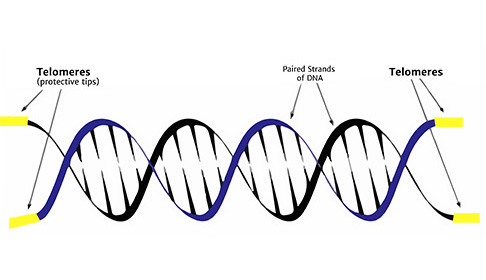
DNA contains all of the genetic material necessary for the expression of traits that involve development, reproduction, and function of the body. It consists of a double-stranded molecule held together by nitrogenous bases. And because it contains so much important information, it needs to be protected from damage. This is the main function of telomeres. Telomeres, as described here, are essentially protective caps that can be found on the ends of each DNA strand. They prevent fraying, and therefore loss of information, so that our cells can function at maximum capacity. Each time a cell undergoes mitosis, the telomeres on the end of its DNA shorten. Essentially, telomeres serve as a means of measuring one’s biological age. 
DNA Telomere
Source: https://www.tasciences.com/what-is-a-telomere.html 

In addition to mitosis, telomeres have been observed to shorten in response to chronic stress, obesity, lack of exercise, and poor diet. Now, research has uncovered a new correlation between children raised in single-parent homes and shortened telomere length (TL). This paper, published by the American Academy of Pediatrics, elaborates on these ideas and investigates juvenile TL as a response to father loss. Researchers found that association between TL and absence of a father was significant “across all types of loss, and by a child’s sex, race/ethnicity, and age at exposure.” Any type of father loss between birth and age 9 resulted in a 14% TL reduction. Divorce and incarceration resulted in 6% and 10% TL reductions respectively. Death was associated with the largest TL reduction at 16%. 

These statistics are especially concerning due to the fact that shortened telomeres have been linked to a string of health complications; meaning children raised in single-parent households are more at risk than those in two-parent households. Based on previous research that investigated chronic stress and TL, this makes sense. While our cells are not aware of parental involvement, it is already known that children raised in single-parent homes are more likely to be exposed to financial, nutritional, emotional, sexual, and physical stressors; among others. Dealing with any of these for long periods of time does not go without effect; even on the cellular level. However, more basic biological research needs to be done before we can confidently conclude about this correlational relationship.

Posted by Meagan Gustafson (8)

Social Butterfly? More Like Social Bird!

Picture obtained from the Internet Bird Collection.

Social structures are something we have all experienced in one way or another. Ever since the origins of humanity and human culture, social hierarchy has been a crucial aspect to our survival and growth as a species. Until recently, many scientists hypothesized that the formation of social structures require complex and large brains. For example, baboons have relatively similar brains to humans and thus often live in multilevel societies. Other mammals, such as elephants, giraffes, and sperm whales have also been known to formulate and live within social structures. However, a study written by Dr. Damien Farine demonstrated that multilayered societies may extend to species that have a relatively small range of cognitive abilities. Previous brief observations of the vulturine guineafowl (Papio hamadryas) suggests that despite the particularly small brain of this species they may have a complex social structure that is not well understood. 

In order to gather conclusive evidence, Dr. Farine observed and studied a total of 441 vulturine guineafowl over a period of one year in Nanyuki, Kenya. Farine and his colleagues counted 18 total groups of guineafowl in this area and attached GPS devices to 58 birds across these 18 groups in hopes of being able to monitor their positions at all times. Usually, one to five birds per group were chosen to be fitted with the GPS devices. Colored bracelets were also placed on the legs of all the birds in the sample in order to help researchers distinguish between the different groups of organisms. 

The results obtained from analysis of the data revealed a number of shocking trends. Researchers noticed that group membership varied little over the year long study as the birds tended to stick with their own pack and were always found within thirty meters of another group member. Additionally, Farine found that not only did many groups interact with one another on a daily basis but many of these groups also showed particular preferences to certain other populations. A number of these birds tended to stick close to one another and formulate small “friendship” subdivisions within the main group where they would spend most of their time. Analysis of the data exhibited that some packs even preferred to sleep together in one giant cluster during the night despite a lack of an overlapping homerange. In other words, particular groups would specifically migrate out of their usual locations to roost with other packs. In the morning, Farine noticed that all of the organisms that slept together at night would eventually disperse back into their original groups instead of remaining as one collective group. 

The brains of vulturine guineafowl are not only small in comparison to mammals, but also are quite undersized when compared to other bird species. Thus, the fact that this species is able to track social interactions and exist in a multilevel society suggests that brain power may not be the only factor that causes social hierarchies to form. This is astounding data as it was previously thought that social structures were limited to only higher functioning organisms. However, after the conclusion reached in this study, it is highly possible that there are a substantial number of cognitively challenged species that have complex social structures which we may not realize. It will be interesting to see where research takes this subject as it is abundantly clear that we still do not know the exact mechanisms leading to the formation of social groups in certain species.

Posted by James Levangie (8)

The Influenza

It's everyone's favorite time of the year, flu season. The flu is a respiratory disease that targets the nose, throat, and sometimes the lungs. Symptoms can be mild or severe and may include fever, cough, sore throat, headaches, and fatigue. It is thought to be spread when infected individuals cough or sneeze and get bacteria into the air that other people come into contact with. Symptoms usually onset between 1 to 4 days and a person is contagious in the first 2 to 3 days after their symptoms begin. Hopefully, the flu shot you received actually works against the strain of flu that is currently circulating because it is not always a guarantee.

Flu vaccinations are not always effective because scientists typically have to guess the strain that will end up circulating in the population. Sometimes, the strains that are incubated for vaccinations are not always great matches for the strains that circulate in the population. Another factor may be that the strains are grown in eggs which can lead to mutations and cause the vaccine to be less effective. The goal of the vaccines is to get the body to produce antibodies to the specific strain of the virus so, if the vaccine contains the wrong strain, then more people will get the flu. For example, the flu vaccination in 2012-2013 was effective in only 39% of people, which is incredibly low.

These types of vaccines may be a thing of the past, though. Recently, researches have found an antibody that they tested in mice. This antibody protected the mice against various lethal strains of the flu. This could potentially mean a universal vaccine for the flu is close. The researches found that the antibody binds to a protein called neuraminidase which is required for the flu virus to replicate in the body. Typically, anti-neuraminidase antibodies are general within sub-types of the flu and do not always work on all strains. Recently, blood samples were examined that showed evidence of an antibody that had potent activity across multiple strains. The researches found that the one antibody protected mice against 12 strain of the flu which was unheard of.

Someday, the fly may be a thing of the past. People will no longer have to worry about if the vaccine they received will have an effect or not. These anti-neuraminidase vaccines might just be the answer to all influenza related problems. We can only hope that the virus does not mutate to become resistant to these vaccines.

Posted by Brianna Luciani (8)

Tuesday, November 5, 2019

Exercised Induced Bronchoconstriction

Have you ever gone to the gym and wondered why you are panting after a strenuous workout? Or have you watched a professional athlete need an oxygen mask after performing the impossible? Being a runner, I was used to feeling shortness of breath after completing a long run, and I was curious to why I always have that feeling. As it turns out, there is a chance that the shortness of breath after exercise can be due to exercise induced bronchoconstriction.

According to this article, exercise induced bronchoconstriction is defined as constriction of the respiratory pathway due to exercise. This happens because of the way we breathe air in during exercise. Some people happen to breathe air in through their mouth, which causes the air to become frigid and dry. This sort of situation also happens when you have a cold and cannot breathe through your mouth. You will notice that overtime, that your throat and mouth will become dry. Nonetheless, this method of breathing causes our airways to begin to constrict which affects the amount of air we can intake. This in turn, causes us to feel a shortness in breath or experience symptoms that are similar to asthma.

If a person has EIB it does not mean that they can no longer exercise or compete in sports. Rather, there are certain medications that have been developed to treat EIB, which allows athletes to be able to continue to compete at peak performance. Some of these medications include montelukast, and bronchodilatorsAccording to this article, people that are trying to maintain an active lifestyle or play a sport for leisure, should try to play sports that are unlikely to cause EIB. An example of a sport that is at low risk of causing EIB is baseball, since there is lots of moist air available and you are only moving for a short internal of time. While exercise induced bronchoconstriction can cause shortness of breath in exercise, it is important to recognize that it is completely normal to be short of breath after exercise.

Posted by: Nicholas Georgette (Group 2)